Metric vs Imperial in Sewing: How to Convert Measurements Without Losing Accuracy
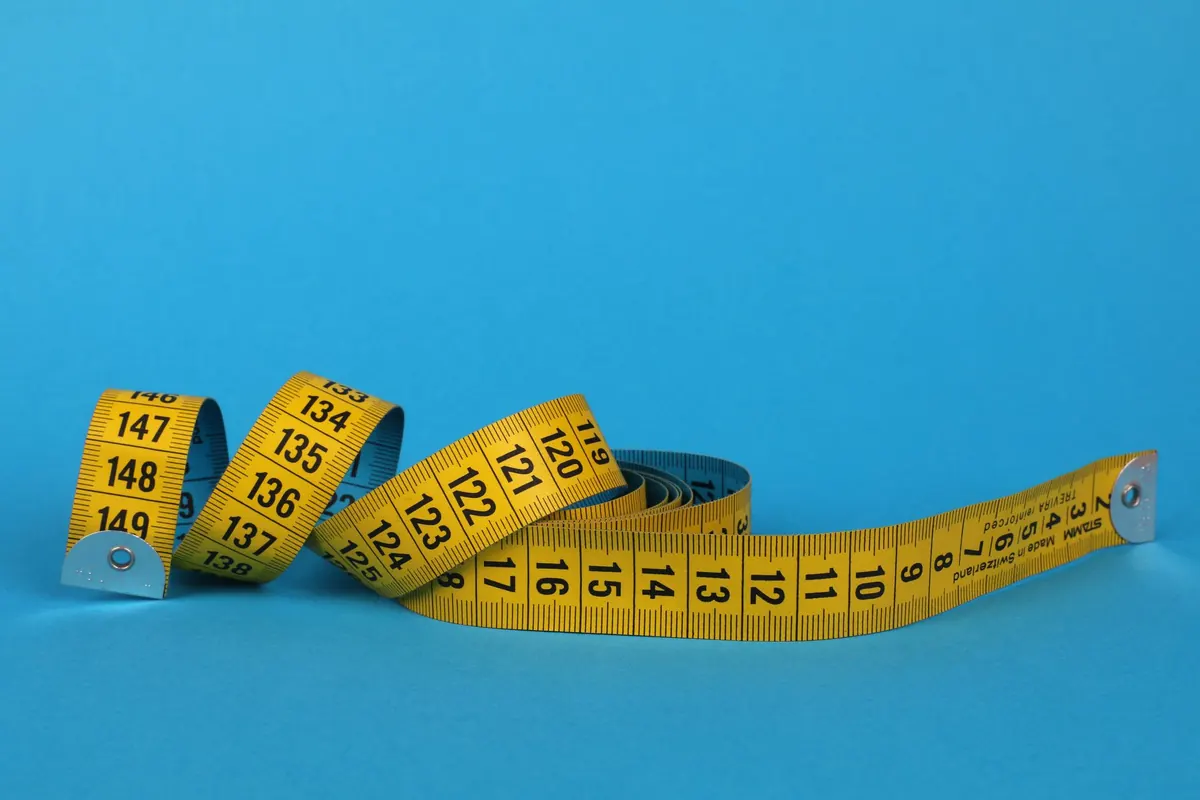
Two tape measures live on my cutting table: one printed in centimetres, one in inches. I reach for whichever matches the pattern in front of me, and that habit saves more time than any conversion chart. Sometimes there is no choice but to convert — a vintage pattern graded in inches, fabric sold by the metre, ribbon priced by the yard, a button labelled 15 mm when the pattern asks for ⅝ inch. The arithmetic is not hard. Where people come unstuck is in the rounding, because a fraction of a millimetre lost at the cutting stage has a way of showing up across a whole garment.
Start with one number that does all the work
One inch is exactly 2.54 centimetres. That is the whole system. To go from inches to centimetres, multiply by 2.54. To go the other way, divide by 2.54, which gives you 0.3937 inches per centimetre.
The trouble starts when we lean on the friendly approximations instead. Treating an inch as 2.5 cm leaves you 4 mm short — invisible on a single seam, obvious on a 1.5 m skirt length, where the gap becomes 2.4 cm.
Anchors worth knowing
- 1 in = 2.54 cm and 1 cm = 0.39 in. Everything else is a variation on this.
- ⅜ in ≈ 1 cm (9.5 mm). Close, but nearly half a millimetre out.
- ⅝ in = 1.59 cm. A metric pattern's 1.5 cm seam allowance is roughly 1 mm narrower.
- ¼ in = 6.35 mm. A 6 mm patchwork seam is 0.35 mm narrow; over forty blocks that is 14 mm of drift.
- 10 cm = 3⅞ in, 30 cm ≈ 11⅞ in, 1 m = 39⅜ in.
- 1 yd = 91.44 cm and 1 m = 1.09 yd.
Converting pattern pieces: convert once, then commit
Do the conversions before you cut anything, not as you go. Read through the pattern, note every measurement you will actually use, and write the converted figure directly on the envelope or a scrap card kept with the pattern. Then work in one system for the rest of the project, including your seam gauge.
Keep two decimal places while you convert and round only at the end. That matters most where a measurement repeats: sixteen darts, twelve buttonholes, a quilt block cut thirty times. Rounding each one by half a millimetre is harmless. Rounding each one by 2 mm is a fitting problem.
Decide the direction of your rounding based on what the measurement does. For fabric, elastic and binding, round up. For fit, round to the nearest millimetre and check against the finished measurement on the pattern, not against your own arithmetic.
Convert once, write it down, and then stop thinking in two units at the same time.
Fabric: convert the width as well as the length
This is where a tidy conversion still goes wrong. A pattern asking for 2 m of 150 cm fabric is not the same as 2 yd of 44 in fabric, because the width changes the layout. Convert both numbers, then look at the cutting diagram again.
Fabric widths you will meet: 112 cm (44 in), 140 cm (55 in), 150 cm (59 in) and 280 cm (110 in) for wide sheeting and quilt backing. If a pattern specifies a minimum width and your cloth is narrower, you will usually need extra length. Add a little more for shrinkage, directional prints, checks that need matching, and the inevitable mis-cut. Buying an extra 10–15 cm is cheaper than a second trip to the shop.
Length guidance: for a shortfall under 5 cm, round up to the next 10 cm. For anything over a metre, convert exactly and round up to the next whole 10 cm. Long lengths and borders in quilting deserve the exact figure, since the error compounds with every strip you join.
Notions, elastic and needles
Small items are sold in whichever system the manufacturer prefers, and labels are not always precise. A few conversions that come up often:
- Buttons are often sized in lignes, where 1 ligne = 0.635 mm. A 40 ligne button is 25 mm, or about 1 in.
- Elastic sold as ¼ in is 6.35 mm; metric stock is 6 mm. Casings need a little clearance either way.
- Bias binding comes as 12 mm (½ in), 18 mm (¾ in) and 25 mm (1 in) — the metric widths are designed to be near enough.
- Machine needles are labelled in both: 70/10, 80/12, 90/14, 100/16.
- Zips are usually sold in round metric lengths. A 22 in zip is 55.9 cm, so a 55 cm zip will do if you shorten from the top.
Rather than converting a stated button size, measure the button itself with a ruler or seam gauge and use that figure for the buttonhole. Labels refer to nominal sizes; the button in your hand is the one that has to pass through the hole.
Where rounding errors actually bite
Most conversions are forgiving. These are the places to slow down:
- Repeated increments. Buttonhole spacing, pleat folds, quilt sashing. Multiply the small error by the number of repeats before you decide it does not matter.
- Seam allowances on multiple seams. Four seams at 1 mm out each is 4 mm off the finished width.
- Long straight edges. Hemlines, borders and curtain drops show a rounding error immediately.
- Dart intake and ease. These are small numbers where a millimetre is a meaningful proportion of the whole.
- Circles and curves. Converting a radius affects the circumference more than you expect, so draft the curve rather than scaling a number.
Habits that keep the numbers honest
- Pick one system per project — ideally the one the pattern uses — and convert everything at the start.
- Keep a tape measure or ruler in both scales within reach, so you can check a measurement instead of calculating it.
- Write converted figures on the pattern in pencil, and note how you rounded.
- Use 2.54, not 2.5, for anything longer than 20 cm.
- Round up for materials, nearest for fit, and check both against the pattern's finished measurements.
- Sew a toile or a test block when the fit or the repeat count is critical. Ten minutes of scrap fabric settles more arguments than a calculator.
Measure the thing, not the label
Conversion is a tool, not a substitute for measuring. Before you cut, check the actual width of the fabric, the actual diameter of the button, the actual length of the zip. Manufacturers round their own figures, and metric and imperial stock are rarely interchangeable down to the millimetre. Lay the tape on the cloth, mark the piece, and cut once — with a single system running from first measurement to final press.
Photo: Ann H / Pexels
Sewing with UK Charity Shop Finds: A Checklist for Upcycling Second-Hand Fabric
How to source, wash, unpick and store second-hand clothes and textiles from UK charity shops so they...
PDF Sewing Patterns vs Paper Patterns: Which Is Better for UK Sewists?
Weigh up cost, printing, storage, sizing and ease of use to decide whether PDF or paper sewing patterns...
About Us